 Problem Solving & Advice by Pam Johnson-Bennett Cat Behavior Expert & Best-selling Author

Does your cat dive under the bed whenever the doorbell rings? Or maybe your cat stands her ground and hisses whenever company comes to visit? Maybe you even have a cat who offers a pre-emptive strike and attempts to immediately sink a few teeth into the flesh of anyone who dares enter your home. Here’s a training exercise you can do with your cat to help ease both of these situations.
Set Your Cat up for Success
Do some preliminary work with your cat. Get a fishing pole-type toy and conduct daily interactive play sessions. Do these play sessions in various parts of the home but also do a good number of them in the room where company would normally enter. The more play sessions you do, the more your cat may begin to have positive associations with all rooms in the home.
You can also use clicker training in this situation. Begin by getting your cat comfortable with the process. Once your cat gets the concept you’ll then be able to click and reward for any positive steps in the right direction.
Environmental Assistance
First on the list is to get a cat tree. A cat tree serves many functions. It’s a place to climb, play, sleep, and in this case, it becomes a safe place. Cats typically feel more secure in elevated locations and a cat tree serves that purpose plus it has the added bonus of containing the cat’s scent. It’s a location where the cat can claim ownership. The rule is though, when kitty is on the tree, it needs to be off-limits when it comes to people attempting to interact. I know it can be tempting for someone to go over and pet the cat who is conveniently at eye level on a cat tree perch, but kitty needs to know the cat tree is safe. If you can’t have a cat tree in the room, at least have a window perch or other options for elevated locations.

Cat shelving or walkways will be another way to help your cat navigate around the room and feel safe.
Cat tunnels can also be a helpful addition when it comes to creating security. This way, your cat can feel a little more invisible when walking into the room. You can purchase soft-sided cat tunnels or you can make your own by taping paper bags together. Covered beds, such as donut, cave style, or “A” shaped will also be a good additional to the environment. Your cat will be able to get cozy while remaining invisible.
The above suggestions have one very important thing in common: they give the cat a choice. Choice is important when it comes to lowering a cat’s stress level or controlling fear. If your cat feels he has the choice to stay in the room and still feel protected, he’ll probably be more likely to hang around instead of darting from the room.
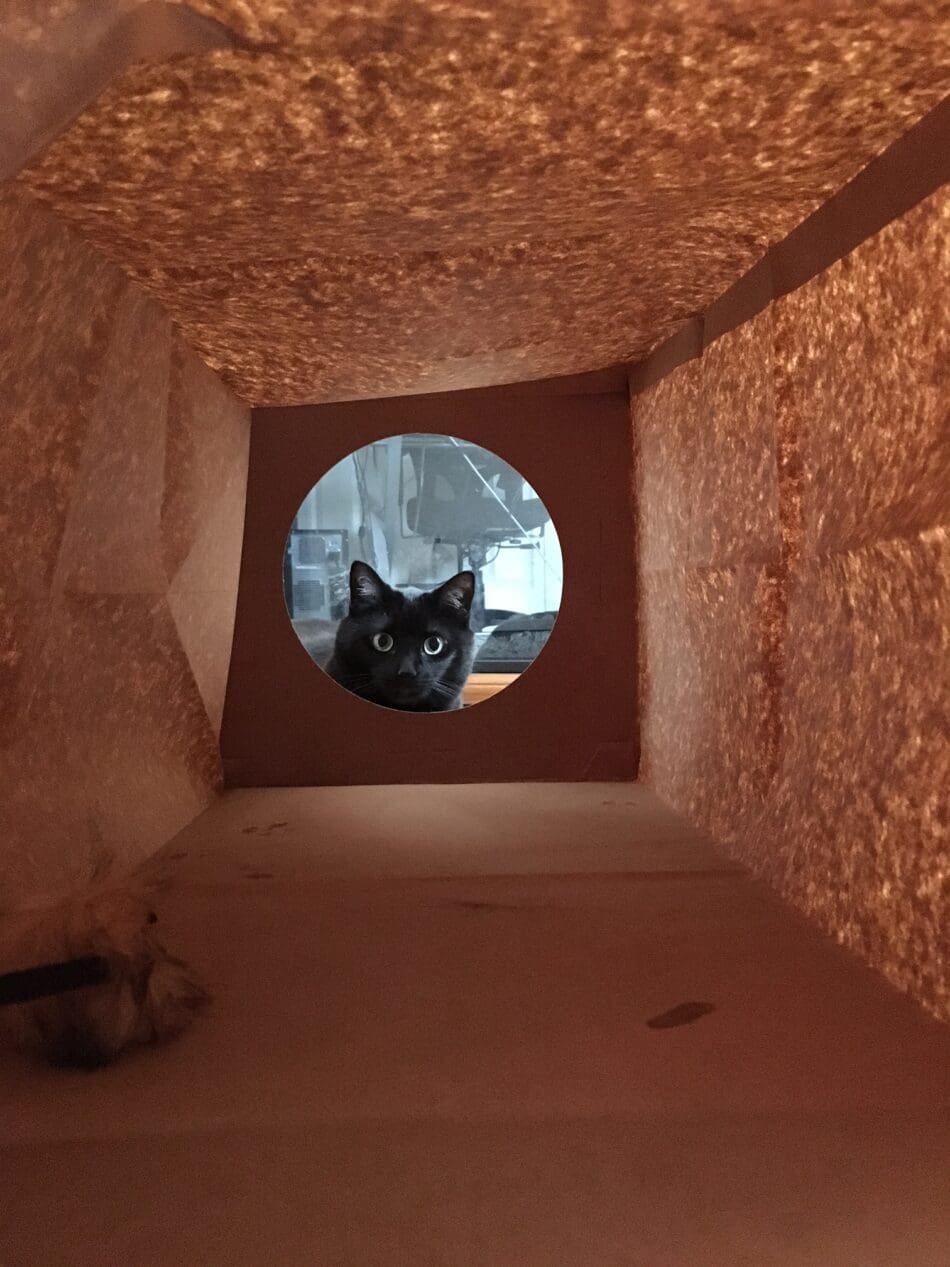
Photo: Pam Johnson-Bennett
Training Sessions
You’ll need a volunteer for the next part of the training exercise. Ask a friend to visit. The purpose of this visit is to show your cat a visitor to the home is not a threat in any way.
Prepare in advance by having your guest come supplied with some of your cat’s favorite treats. When your guest enters the home, they can toss a treat or two in your cat’s direction to see if that works as an initial ice-breaker. Make the whole process very casual — just a few treat tosses and then move on.
Ask your friend to come in and sit down without making any eye contact with your cat. The guest also shouldn’t touch or interact with the cat. Direct eye contact can be viewed as threat to animals so that’s why it’s important for the visitor to not look at the cat.
When you do the training session, pay attention to lighting and noise. If it’s nighttime, adjust the lighting so it isn’t very bright. Your cat will most likely feel a little less vulnerable without bright light in the room. Noise is a factor as well. Don’t have television blasting or loud music playing. I recommend having soft music in the background such as calming classical or new age. Another aspect of noise to consider is vocal volume and tone. Keep your conversation with your visitor in a calm and reassuring tone — no loud voices or laughter that might startle your cat.
Time your training sessions when the house will be calm. Don’t do a training session on the afternoon that your spouse will be mowing the lawn or the exact time the kids will be expected home from school.

The Scaredy Cat
When the visitor comes in, if your cat runs and hides, don’t panic. Let your guest get settled, take a few minutes to visit and then excuse yourself so you can go check on your cat. Casually go to kitty and conduct a low-intensity play session to a minute, if they’re up for it. Don’t drag the cat out from under the bed or poke the toy in his direction. If the cat is under the bed, just sit on the floor nearby and casually move the toy in an enticing way. The message you want to convey is that everything is fine and that there’s no need to be afraid. You cat may peek out to play or stay hidden. It doesn’t matter. The message will be received. If your cat does come out, do a mini play session. If the cat peeks his head out from under the bed, click and reward. Any baby steps should be rewarded. Then, go back to your guest. This brief visit with your cat conveys the message that all is ok in his world. If your cat sees your demeanor hasn’t changed and that you’re very calm, it may help him feel less stressed. Remember, cats are little emotional sponges and they easily pick up on our emotions. If you’re worried or you try too hard to interact with your cat, you’ll just set off alarm bells in his head.

Photo: Pam Johnson-Bennett
If your cat ventures out of the bedroom and makes an appearance in the room where your visitor is located, click and reward. You can also have the interactive toy nearby and conduct another play session. Keep the toy a good distance from the visitor though so your cat can stay within his comfort zone. Again, your demeanor matters here. Be calm, use a soothing tone of voice and act as if all is perfectly ok in the cat’s world.
The Watch Cat
For a cat who takes on an aggressive approach with visitors, you can do the same technique. Make sure the visitor makes absolutely no attempt to interact. Click and reward the cat for looking at you or moving away from the door. Call your cat to a specific location (such as the cat tree) and click and reward when he responds.
Conduct a low-intensity play session with your cat or offer treats when he’s in the room with the visitor. You can even feed your cat a meal while the visitor is there. Just be sure the cat is far enough away so he feels safe and secure.

Let Your Cat Investigate
You may find your cat tentatively walking over to the visitor. This doesn’t mean your guest should reach over and pet the cat or attempt to pick him up. Your cat is probably doing a scent investigation. The cat might approach and sniff your guest’s shoes. Let the scent work proceed without interruption. The cat needs to determine your visitor is not a threat to the territory. Keep in mind that scent is very important to cats and someone who comes into the house is also bringing in unfamiliar smells.
If your cat is comfortable and at ease or seems to be wanting interaction after a couple of training sessions, you can instruct your guest to extend an index finger for the cat to sniff. This is the equivalent of nose-to-nose sniffing that two friendly cats would do upon approaching each other. Your cat may sniff the guest’s finger and rub against it or back up and walk away. Let the cat set the pace when it comes to interaction.

Photo: Pam Johnson-Bennett
Every Cat is Different
If you do this exercise a few times a week, your cat may begin to realize visitors aren’t threatening. Even if your cat doesn’t become the social butterfly you were hoping for, it’ll be very helpful to not feel frightened or threatened whenever someone comes to visit. Your cat may always choose to disappear into another room and that’s ok. The cat just needs to feel as if he always has safe options.
Getting Extra Help for a Cat Displaying Aggression
If your cat becomes very aggressive when visitors are in the house, the best solution to ensure everyone’s safety is to always provide your cat with a safe and comfortable room while you have company. Talk to your veterinarian about a referral to a certified behavior expert who can help customize a specific plan for you based on your individual cat and the level of aggression displayed.

Need More Information?
For more information on cat behavior and training, check out the best-selling books by Pam Johnson-Bennett. Pam’s books are available at bookstores and online. We’ve included Amazon links here on our site.
If you have a question regarding your cat’s health or are concerned about a behavior issue, please contact your veterinarian. This article is not intended as a replacement for your cat’s veterinary care.
