 Problem Solving & Advice by Pam Johnson-Bennett Cat Behavior Expert & Best-selling Author
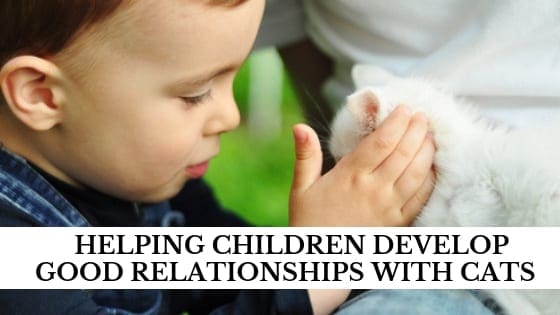
Your cat and your child can develop a close and wonderful relationship. Take the time to demonstrate to your child the correct way to interact as soon as they become aware of the cat. Provide your cat with areas of safety and refuge. With a proper introduction and training, the blossoming relationship can start your child on a lifetime of showing tenderness toward animals. From the cat’s point of view the key to initiating and establishing a good relationship begins with trust.
Create Cat Safe Zones
The cat needs places in the home he can count on to be his sanctuaries. The feeding station and litter box areas should be located where he can use them without being disturbed. If your children are too young to understand when and where the cat needs to be left alone, then you’ll have to create areas that only your cat can access. This may include putting the litter box in a room with the entrance blocked by a baby gate that has a small pet opening in the middle so your cat can go through. The food and water bowls may have to located on an elevated surface out of a child’s reach. Just be sure your cat can easily climb or jump there.
Cats feel more secure when they have elevated locations to avoid interaction or even just for napping. A cat tree is beneficial to the environment to provide easy access vertical territory. Window perches are another idea. You can also create vertical territory by installing cat shelves and cat walkways on the wall. All shelves and walkways must be sturdy and covered in non-slip material. If your cat feels there are choices when it comes to engagement or avoidance, it help reduce stress.
As you look around your home, see what areas need improvement to ensure your cat has options for escape, vertical territory, and the ability to use resources undisturbed.
Follow Feline Etiquette
There’s a universal way cats who are familiar with each other use as an opening greeting. They’ll slowly approach each other and engage in an initial scent investigation through nose-to-nose sniffing. It’s after this that they’ll determine whether to interact more or back away. If your cat is approaching, have your child extend an index finger out front. If your child is the one doing the approaching, show them how to walk up to the cat slowly. If your child runs, the cat may interpret that as being chased and run for cover. It’s important to show your child how close to get to the cat before sticking out an index finger. The child shouldn’t hover over the cat but just present the index finger close enough so the cat doesn’t have to get up to sniff it but not so close that it’s an intrusion on his personal space. As an adult and as someone who knows your cat’s body language, Identify whether the cat’s body language reflects an openness for this potential interaction. If your cat’s ears are flattened back, if there’s any growling or display of defensiveness, then this isn’t the time for an attempt at physical contact.

Your child shouldn’t stick the finger in the cat’s face. Show your child how to merely extend a finger as if it’s another cat’s nose. This will give the cat an opportunity to do some initial sniffing. The cat is the one who has the choice of whether to approach or not. If he wants to interact with your child, he’ll rub against the finger or move closer. If the cat doesn’t want more interaction, he’ll stay still or move away. Explain to your child that cats use scent as a way to gather information and communicate. Cats use scent as a form of recognition. The opportunity to sniff your child’s finger is close to how two feline friends would approach each other.
If your cat chooses not to sniff the finger or merely sniffs it and backs away (or if the cat was already stationary, he may turn his head away), then that’s a sign no interaction is desired. If your child understands that and moves away then it begins to build trust because the cat will feel as if there are choices. When you give your cat a choice it helps prevent him from defensive reactions due to feeling trapped in a corner. That’s the foundation of trust-building.
Pet the Cat With an Open Hand
The incorrect petting technique can squash a budding relationship. Show your child how to gently pet with an open hand and to stroke in the direction the fur grows. Some cats have sensitive areas or definite preferences when it comes to certain body locations. Instruct your child on the areas to stay away from. If you have more than one cat, each one may have very different likes and dislikes so teach your child that what one cat enjoys may not be what the other likes. In general, many young children pet by patting the cat and most cats don’t enjoy that kind of touch. The overall preferred method is to use smooth strokes. The typical place cats enjoy being petted is on the back of the head. Some cats like long strokes down the back but for other cats that’s either too stimulating or too sensitive. Know what your cat likes so you can instruct your child correctly.
With some cats there’s a window of opportunity when it comes to how long they enjoy being petted. If you know that about your cat you can offer your child some guidelines. If your child is old enough to be aware of body language show them what to watch for that could indicate the cat is reaching the tolerance level. If your child is very young then you need to supervise so you can stop the interaction long before things start to turn. To further build trust, instruct your child that no matter how much the cat may enjoy the interaction, if he moves away it means he is finished. If your cat feels he has the choice to stop the interaction when he has had enough it’ll go a long way in building a bond.
Create Special Games for the Cat and Your Child
Cats love to play. Children love to play. Children love to play with pets. Help your child pick out a cat toy – preferably a design that resembles a fishing pole – and show how to conduct a play session with the cat. Teach your child not to poke the cat or point the toy in his face, as well as not frustrating the cat by keeping the toy out of reach. Place open paper bags on their sides and have your child try to get the toy in each bag. Both your child and the cat will have fun. If you use a fishing pole design toy, make sure the child is old enough to understand how to move the toy and not poke the cat. If the child is younger or you’re at all concerned, use something like a peacock feather or a soft snake-like toy such as the Cat Charmer. Another option is to have your child use a wand to create catnip bubbles. These bubbles can be purchased at your local pet product store or online. Don’t let your child blow the bubbles in the cat’s face. Of course, all playtime interaction should always be supervised by you.

A Young Cat Trainer in the Making
Clicker training is a wonderful, positive and effective form of training a cat. If your child is old enough, demonstrate how to do some basic clicker training with the cat. One of the easiest things to teach is “sit” or your child can use the clicker to train the cat to come when called. You can find information in my book, CatWise. I would also recommend watching some YouTube videos so your child can see first-hand how much fun it is to use clicker training.
Read About Pets
There are several books written for children about pets or tell stories about cats or dogs. Use story time as an opportunity to help your children develop more compassion and understanding about how animals feel and what they need. One of the things I frequently did during story time was to ask my children how they thought the cat or dog felt when something good or bad happened.

Model the Behavior You Want in Your Child
Your child is learning from watching how you care for and interact with the family pets. On a daily basis, demonstrate that your cat needs proper healthcare, good nutrition, love, fun, and kindness. If your child sees you reprimanding the cat in an inappropriate way, there’s a chance they will do the same. Even how you talk about the family cat can influence how your child views the relationship. Referring to the cat as stupid if they do something undesirable will send the wrong message to your child. You hold the key when it comes to whether your child and your cat develop a good or bad relationship
Need More Information?
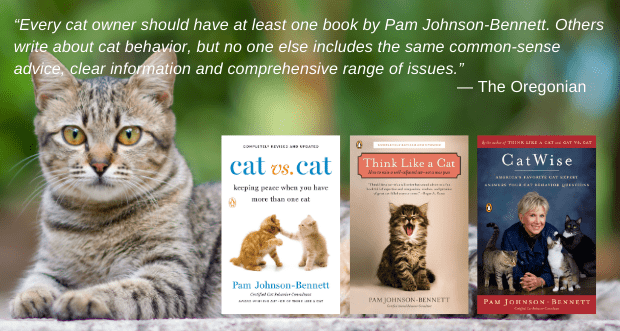
For more specific information on cat behavior, cat training, and cat behavior problems, refer to the books by best-selling author, Pam Johnson-Bennett. Pam’s books are available at bookstores and online. We’ve included Amazon links here on our website.

If you have a question regarding your cat’s health, please contact your veterinarian. This article is not intended as a replacement for your cat’s veterinary care.
