 Problem Solving & Advice by Pam Johnson-Bennett Cat Behavior Expert & Best-selling Author
Cats, despite what you may have been told, aren’t solitary creatures and many of them benefit from having feline companions. That said, cats are also territorial so the introduction process requires some finesse and patience. If you just toss the cats together with a they’ll work it out themselves mentality, you will put a tremendous amount of stress on both cats as well as risk physical injury to them. An incorrect or hurried introduction can set the cats up to become bitter enemies. On the other hand, the correct introduction can open the door to a lifelong feline friendship.
Cats in High Alert Mode
You may know some people who used the old-fashioned (and not well-thought-out) method of simply putting the cats together and letting nature take its course. Some of these people may have had successful outcomes but at what cost? How stressful were the introductions? And, did the cats really become friends or did they merely divide up the territory and draw a line in the sand? Just because these cat parents don’t see overt aggression doesn’t mean these cats aren’t living under constantly stressful conditions. The let them work it out method is risky, ineffective, and inhumane. Why would you want to use a technique that puts all cats involved at risk?
Do it the Right Way When Introducing Cats
The way I tell my clients to do new cat introductions is to take it one sense at a time. First the cats may hear each other (if one or both are vocal), then they’re going to smell each other (in a controlled way via my behavior method) and then they’ll see each other (again, in a controlled way). Finally, they may touch each other (we definitely want this to be controlled and positive). As for tasting? Well, that’s optional if one cat eventually licks another. Hopefully, the tasting aspect won’t involve any biting though.
The proper new cat introduction technique must address the emotional and physical needs of both cats. From the resident cat’s perspective, there’s an intruder in the territory. From the newcomer’s point of view, he has just been dropped on hostile turf. Both cats need to feel secure. If they feel as if there’s no safe place for them, that’s when they’ll revert to survival mode and you’ll see panic, fighting, and perhaps spraying. If, however, they feel they can remain in their comfort zones while checking out the situation, you can usually keep a lid on the panic button. Both cats need safe areas to decompress during this life-changing event — and it is a life-changing event. Your resident cat doesn’t understand why he no longer has the entire territory to himself and the newcomer must get to know an unfamiliar territory, unfamiliar humans, AND an unfamiliar cat. Talk about stressful!
Step One: Set Up a Sanctuary Room
Set up a room to be used as a safe place for the newcomer. This gives him time to get somewhat familiar with his new surroundings in a more secure way. It’s stressful enough for a cat to move to an unfamiliar environment so before you attempt to introduce him to your resident cat, let him get his bearings and have time to himself in a sanctuary room. You don’t want to even attempt an introduction with a reactive newcomer so the sanctuary gives him a place to get back to normal functioning level. The more relaxed each cat is, the better the chances of a successful introduction.
The sanctuary room can be any room you can close off. It should contain a litter box, food/water, a few cozy hiding places, a scratching post, and toys. If you use a carrier to bring the cat into the house, leave the carrier in the room with its door open so the cat can stay in there if he chooses before venturing out into the rest of the room. If the newcomer kitty is timid or fearful, being able to stay in the carrier containing his own familiar scent may provide much needed comfort in the beginning.
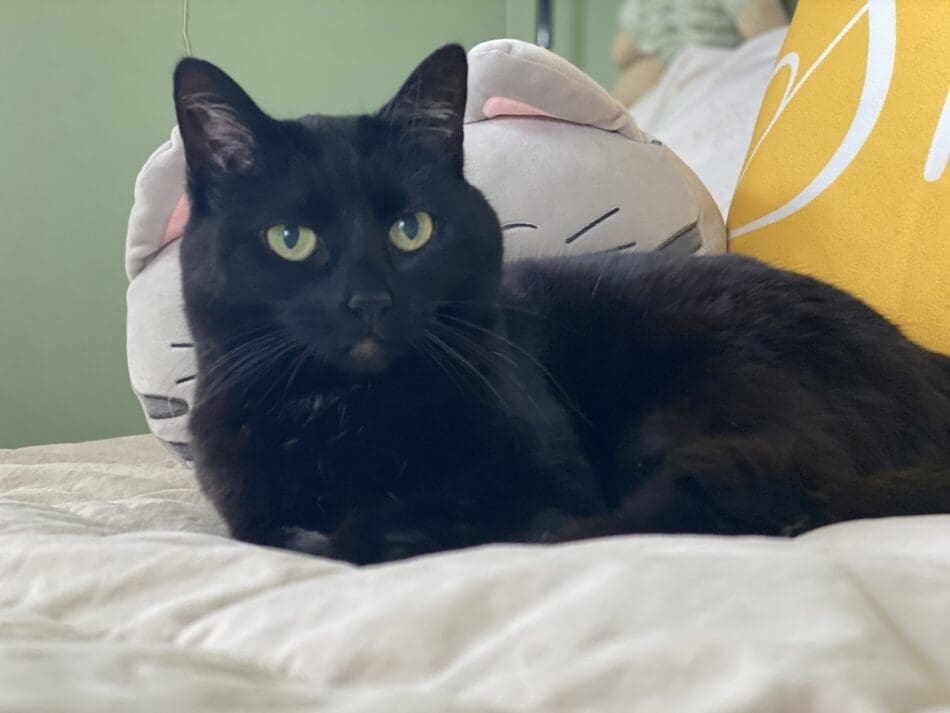
Photo: Pam Johnson-Bennett
For a fearful cat, set up some paper bag tunnels as safe ways for him to get to resources. That way, he can get to the litter box or food without feeling too exposed. Put other hiding places around the room for him as well, such as upside-down boxes with entrance holes cut in them. This may help the newcomer feel as if he doesn’t have to remain hidden under the bed or in the closet. If he spends his days cowering under the bed and wedged behind your suitcase in the closet, he’ll be too frightened and reactive and that will lead to an unsuccessful and extremely stressful introduction.
I Know You’re in There!
Even though your resident cat won’t be able to see the newcomer, he’s going to be aware of the fact that he’s on the other side of the door. This is normal but by having the newcomer in the sanctuary, you’re letting your resident cat know that only a portion of his territory has been invaded and not the entire home.
Step Two: Mealtime = Cat Training Time
The key to a successful new cat introduction is to give the cats a reason to like each other. You can’t just separate them for an extended period of time and then open the door expecting them to magically form a bond. They’ll need to see good things happen when they’re in the presence of each other, and later, within sight of each other. The best way to do this is with food and treats. Food is a powerful motivator!
Feed the cats by placing food bowls on either side of the closed sanctuary door. How far from the door itself will be determined based on the reactivity level of each cat, but in general, it’s best to start very far apart. If your resident cat won’t come within six feet of the door then place his food bowl well within his comfort zone. In subsequent sessions you’ll gradually move the bowls closer and closer to the door itself.

If one cat eats faster than the other you can give that cat a bowl with some obstacles in it (such as a slow feeder bowl used for dogs who eat too quickly). You can also push the food against the bottom and sides of the bowl (as opposed to just placing a heaping mound of food in the center) so the cat has to spend more time licking at it. You can also place wet food on a Lickimat.
Don’t offer too much food during each training session. It’s better to do frequent sessions that are short and that end on a positive note.
With each feeding session you will move the bowls closer to the closed door. I often mark the spot with a piece of painter’s tape so I’ll know where I left off previously. If you get to the spot where one cat gets upset then it’s time to back a step. Remember, the door is to be closed as you inch the food bowls closer. The cats aren’t ready to see each other yet.
Step Three: Let the Nose do the Talking
The Sock Exchange
This is the method I came up with many, many years ago and has been very successful with new cat introductions. It’s very simple and it starts with a pair of clean socks.
Place a clean sock on your hand and gently rub the newcomer along the face to collect some facial pheromones. Pheromones are scent chemicals that are released from a cat’s scent glands. The pheromones around the cat’s face (along the sides of the mouth, on the chin, cheeks and on forehead) are basically “friendly” pheromones. Cats facially rub on objects in locations where they feel comfortable. So by using the sock, we’re going to create a simulated cat that contains lots of friendly pheromones.
Place the scented sock in your resident cat’s area. This will give him a chance to do his own initial investigation of the new cat’s scent.
Let your cat do his own investigation. I use clicker training with introductions and I click and reward any positive move the resident cat makes toward the sock. I click and reward for merely walking toward the sock. I click for anything I would like to see the cat do again and I ignore any negative behavior. For example, if the cat sniffs the sock I click and reward. If he walks by the sock without giving it a second look I click and reward.
The reason I use the sock is that it gives the cat time to get to know the other cat’s scent in a safe and controlled way. The cat doing the sniffing can safely approach and I can do behavior modification without worry that one or both cats will get injured.

Take the mate to that sock and rub the resident cat to collect the facial pheromones and place that sock in the newcomer’s sanctuary room.
You can do the sock exchange as often as needed. You also don’t have to use clicker training — it’s optional. If you prefer not to use it, then either offer a treat to the cat for any behavior you want to encourage. If you don’t want to give treats then you can use a portion of his food. This method will only work if you feed on a schedule rather than having food available all the time. If you’ve always kept food down for free-choice feeding, this might be the time to reconsider going to scheduled meals. Food is a powerful tool for behavior modification but it won’t work if the cat is never hungry.
When it comes to rewarding the cat’s behavior as he comes upon the sock, keep in mind the behavior doesn’t have to be over-the-top-great; it can be a very neutral behavior such as the cat simply walking by the sock. He doesn’t have to roll all over it in order for this to be a positive behavior. We’re looking for any sign of relaxation or acceptance.
Now it’s time for the newcomer to start investigating and exploring his new territory and spreading his scent around the environment. This has to be done safely so your resident cat will need to be placed in a separate room. Then open the door to the sanctuary room and let the newcomer check things out. As he walks around he’ll be distributing his scent around the house. Do this exercise a couple of times a day.

Depending upon how reactive your resident cat is, you can also let him do some exploration of the sanctuary room. Put the newcomer in another room so he can explore safely (or place her in her carrier and put then put the carrier in another room) and then open the door to the sanctuary room so your resident kitty can check things out. Keep toys and treats handy for distraction. Whether to let your resident cat into the sanctuary room depends on how reactive he is so you’ll have to be the judge here. For some cats, the sanctuary room of an unfamiliar cat is too over-the-top. For other cats, it’s a chance to do a more in-depth scent investigation in a safe way.
Step Four: Peek-a-Boo Kitty
The next step involves opening the sanctuary room door just a crack during the feeding sessions. Feed the cats within sight of each other but far enough apart so they don’t feel threatened. The best way to do this is to go back to the spot where you originally began the feeding sessions — on opposite sides of the rooms. Do short sessions where you’re offering a tiny amount of food and then close the sanctuary room door. It’s better to do several short sessions a day that end on a positive note rather than attempting one long session where someone’s tolerance is tested and a fight breaks out. If one cat routinely tries to bolt through the door, use a door stop to prevent the door from fully opening. You can also place a hook-and-eye closure on the door temporarily.
Each feeding session will involve inching the bowls closer together. Don’t be discouraged if you have to stay at a certain distance for several sessions. Remember, it’s important that the cats set the pace.
Step Five: Fully Opened Door
When do you move onto this step? That’s determined by your individual situation. There’s no set time limit on how long you should stay in one phase before entering the next. If your cats aren’t comfortable enough yet with eating on either side of the door when it’s cracked open then you aren’t ready to move onto to the fully opened door. Cat introductions shouldn’t be rushed. Take each phase slowly and watch your cats’ reactions to determine whether to move on.
When it comes time to open the sanctuary room door and you’re worried one cat may charge through or if one or both cats have already attempted that then you take an interim step by putting a tall gate across the doorway, or two or three baby gates, or install a temporary screen door. This will allow the cats to see each other without being able to charge. When the short feeding session is over, close the actual sanctuary room door again. You can even use just one gate during the feeding sessions if you’re standing by the door ready to close it in case the worst happens. There are some very tall gates available at pet supply stores and online, and they work well for new cat introductions. Even though the cats could easily hop over the gate, it can become a psychological barrier — just enough of one to relax the cats so they’ll be comfortable to eat.
Keep doing sessions where the cats see each other while eating or getting treats. Gradually increase the exposure time.
Continue the Clicker Training
As you gradually increase the time the cats are exposed to each other, use clicker training and click and reward for any positive move. I tell my clients to click for any absence of an unwanted behavior. For example, if one cat breaks a stare or walks by the other cat without hissing or swatting – that deserves a reward. Again, even if you’re not using clicker training, offer a food treat or verbal praise for any positive sign.
Photo: Pam Johnson-Bennett
Use Playtime
Use interactive playtime as a way to help the cats have more positive experiences with each other. Do parallel play by having a fishing pole-type toy in each hand or enlist the help of another family member. This way, each cat will have their own toy. You don’t want the cats competing for one toy or risk having a cat feeling intimidated by another cat. When you use two toys they get to enjoy the game while seeing the other cat in their peripheral vision.
Puzzle Feeder Distraction
In addition to playtime, try some irresistible food rewards to keep the cats distracted. A little Churu paste on Lickimats (one for each cat), or even a little wet food on Lickimats. I often use Churu because most cats can resist the taste. Just a little embedded on a Lickimat may keep the cats distracted with something positive while still being aware of each other in their periphery. You can find both of these products at your pet supply store or online.

Photo: Pam Johnson-Bennett
Final Step: The Cats’ Environment
Set up the environment to encourage security, fun, and plenty of territory for everyone. This will be very important when the cats are spending more time together and no longer separated. Use cat trees, perches, and hideaways to create low, medium, and high levels. If you increase the elevated territory in the environment you’ll greatly increase the cats’ perception of the amount of territory they feel they have. Vertical territory also helps a cat feel safe because he knows he can’t get ambushed from behind and he has more visual ability to survey the environment. Some cats also use vertical territory as way to display status and it can often avert an actual physical confrontation.
Increase environmental enrichment to give the cats ways to divert their attention, release energy and have fun! Set up food-dispensing toys, puzzle toys, and other opportunities for solo playtime. A bird feeder outside the window or some cat shelves for climbing and playing may divert attention and ease tension.

Have more than one litter box and more than one scratching post in the environment. The litter boxes and scratching posts shouldn’t be in the same room because you don’t want one cat having to cross another cat’s path. Place important resource items in each cat’s preferred area. This will give the cats more choice and often helps when it comes to a peaceful co-existence.
Continue to do the mealtime training where the cats eat in the presence of each other but keep in mind that they may never feel comfortable enough to eat too close together. Don’t try to feed them out of one bowl. Cats aren’t social eaters. It’s a good idea to feed in separate bowls anyway because it’ll train them for the possibility in the future of one cat having to be on a special nutritional program.
Remember… Don’t Rush the Cat Introduction
I always advise clients to go at the pace of the most stressed-out of the cats. If one cat is ready and willing to make friends but the other cat isn’t, you have to go at the pace of the unhappy kitty. New cat introductions take time but it’s worth it to increase the odds of helping these two cats develop a good relationship.
Need More Information?
You can find the latest information on cat behavior in the revised and updated edition of Cat vs. Cat, the best-selling book by Pam Johnson-Bennett. Pam’s books are available at bookstores and online. We’ve included links to Amazon here on our website.
