 Problem Solving & Advice by Pam Johnson-Bennett Cat Behavior Expert & Best-selling Author

In order to make a good match and keep both the cat and dog safe, do your homework so you can try to create a compatible match. Once you’ve picked a companion you’ll need to do an appropriate introduction. If you attempt to simply put a cat and dog together in order for them to “work it out” you’ll be creating a dangerous and potentially deadly situation.
Make a Good Match
Think about the personality and disposition of your current pet. If you have a dog who has been allowed to chase squirrels, cats, birds, rabbits, etc, and has a high prey-drive, then adding a cat to the household would probably not be a wise idea. If you know from past experience that your dog has displayed very aggressive behavior toward cats then that’s also a sign getting a cat would be too dangerous.
If you’re thinking about getting a dog for your cat and you know from past experience your cat has displayed aggressive behavior toward dogs or has displayed extreme fear when a dog is in sight, then you might be adding too much stress to her life with the addition of a dog.
A cat who is in good health with no mobility limitations would probably be more receptive to the addition of a dog into the household. A cat with limited mobility, whether due to illness, age or injury, would not have the speed or flexibility to run away from the dog or access elevated safe areas. The same applies to a dog with limited mobility — it wouldn’t be wise to pair him with a rambunctious kitten who will test his tolerance. If you have a large dog or one who has been allowed to play on the rough side, then consider adding a confident, agile adult cat to the home and not a small kitten. Take your time to find a good match. Don’t be impulsive when it comes to finding the right companion for your cat or dog.

Photo: Pam Johnson-Bennett
Try to match complementary personalities. Don’t get a timid cat for a rambunctious dog. Don’t match a nervous dog with a revved up kitten. Look for personalities and dispositions that will go together nicely, rather than being on opposite ends of the temperament scale.
No matter how friendly and laid-back your cat or dog is, plan on keeping the resident pet and newcomer separated while you do a slow, safe and positive introduction. Your plan should never include just putting them together and hoping they become friends.
If your dog is not leash-trained and doesn’t have a good recall or isn’t trained to the cues for sit, stay, and leave it, then these these things need to be worked on before attempting to introduce another pet. Use treats and a positive approach to training. If you haven’t been successful with training your dog, consult with a professional trainer to help you.

Pre-Introduction
Before the two actually meet, there is some prep work to be done. If you’re bringing a new cat into the home keep in mind that everything about you and your environment will be unfamiliar. Before tackling a dog/cat intro, give the cat time to get her bearings. Set up a sanctuary room for the cat that is equipped with a litter box, scratching post, toys, food/water bowls, and places to hide. The sanctuary room should provide enrichment and security and not be a cat prison. Don’t just lock the cat away in a room without plans for her mental, emotional and physical health and happiness. The cat needs time to get comfortable in the new surroundings and get comfortable with you before you try to introduce her to the dog. It will also be important to put the dog in a separate area periodically so you can let the cat start to venture out to get to know the house and her new environment when she feels more comfortable. This way, when you do start the introduction she’ll be familiar with her escape options and areas of safety, which will increase her confidence. Cats are territorial and take comfort in familiarity so this step is an important one to help your new feline family member begin to feel at home.
If you’re bringing home a new dog, the same enrichment needs apply to his sanctuary room. If the newcomer is a puppy, plan for lots of enrichment and social needs. The separation should never be a time of loneliness and isolation. Your new dog needs exercise, things to chew, toys to play with, cozy places to sleep, and lots of time with YOU.
The time of initial separation is time you should use to engage your new cat or dog in plenty of playtime and to start building bonds with you.
Pre-Intro Scent Swapping
Place something in each pet’s area that contains each other’s scent. The easiest thing to use is a towel or blanket that has been used by the pet for sleeping. When the pet sniffs the other pet’s scented object, offer treats. Do several scent-swapping sessions over the next few days. If you have been letting the cat or dog out of the sanctuary area to investigate, I know each pet will already be picking up scents but this will be more targeted. You’ll be able to reward for the exact behavior of sniffing the other pet’s scent.
The Introduction
Before you begin actually introducing the two pets, clip your cat’s nails to reduce any potential damage should the unthinkable occur. Take your dog for a good walk or engage in playtime so he’ll be more relaxed and not revved up.
Now for the actual intro: Put your dog on a leash. The leash should be kept short but loose. Place the cat in a room with a baby gate to prevent the dog from gaining access should he slip out of your grasp. You may need an extra tall gate, depending on the side of your dog. Make sure the baby gate is sturdy and installed securely to prevent it being knocked over. Lay a towel over the baby gate to prevent the pets from seeing to0 much of each other at first. As you proceed with training, you’ll adjust the towel for more visibility and then eventually remove it altogether, but for now, limited visual access may be needed to allow the pets to slowly adjust to each other. Sit outside the room with your dog and reward him with treats and praise when he focuses on you and not on the cat. You can have toys for him as well. Start at a distance that’s far away from the room so both pets feel comfortable. Clicker training is great tool to use in this situation so you can click and treat the dog for a relaxed body posture or for turning his attention to you. If the dog gets tense and starts staring at the cat, divert his attention. When he breaks the stare, click and reward.

Photo: Pam Johnson-Bennett
If the cat is the resident and she feels safest and more secure being in the main part of the house where she has access to things such as her cat tree or other elevated options, then let her have that freedom. What will provide the most security for the cat is knowing she has control over her location and options for escape.

If the dog is not comfortable, move farther away from the cat’s area. As the dog gets more comfortable you can then move a few inches closer. What you’re hoping to achieve is a predictable pattern of comfort and relaxation.
Stay at a distance that’s comfortable for the animal who is most stressed out. If the cat is too afraid to be in sight of the dog, then it’s time to move farther away. Find the distance that puts the pets at ease and less on high-alert.
If you can enlist the aid of a helper during training, that would be great. The helper can sit in the room with the cat and offer treats or some favorite food when the cat sees the dog. If you don’t have a helper, place something in the room to distract the cat such as some Churo paste embedded on a Lickimat or whatever treats, food or toys the cat can’t resist. You can find these products easily online.
In subsequent sessions, reduce the size of the towel blocking partial viewing access until both pets can see each other completely. When that goes well, you can remove the baby gates to give the cat more freedom. Work up to having the cat roam around the room while the dog is on leash. Continue to reward the dog for relaxed behavior. If you have a helper, that person can reward the cat with treats or food as well. If the cat runs and hides in another room and seems too terrified, then it’s time to put the baby gates back up and take a few steps back.
Watch the dog’s behavior and remember to reward him when he relaxes, focuses on you or follows your cues. If he lunges, growls, barks or stares at the cat, move him away and then back again as he relaxes. He’ll learn calm behavior allows him to stay closer to the cat but rambunctious behavior causes him to have to leave the area. Don’t yell at your dog or jerk on the leash during this process – simply walk him away from the area and allow him to try again. If he gets reactive then walk away again. He’ll eventually get the idea that calm behavior is the best option.
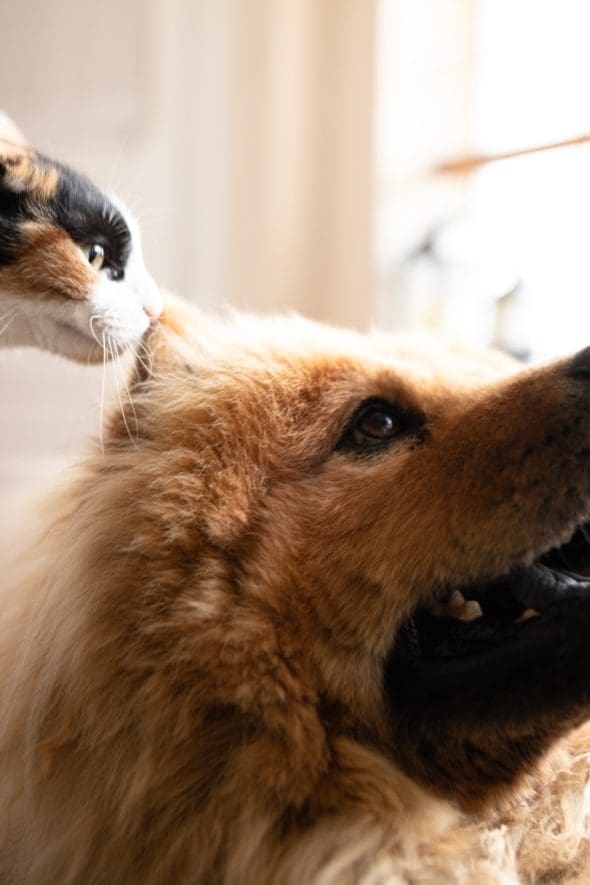
Photo by Callum Shaw on Unsplash
Keep Training Sessions Short
Don’t try to do a marathon introduction in one or two days. It’s better to do several short training sessions each day to minimize stress. Try to end on a positive note each time so the animals will be more inclined to advance in progress during the next session. It’s also important to not overwhelm the cat or dog with too much exposure all at once. One or both of the pets may need time to recover.
Making Progress
During the introduction sessions (and it’ll take many training sessions), if at any time the dog tries to aggressively go after the cat, or the cat appears totally panicked or dangerously aggressive, then this is not a safe situation and you need to completely separate them. If you feel uncertain as to whether the situation might improve, contact a professional trainer or certified behavior expert to work with you.
During the introduction phase keep the cat and dog separated unless you’re there to supervise. Keep the dog on a leash until you’re absolutely sure both animals are comfortable with each other. Never leave the cat and dog unsupervised – even for a few seconds if you’re not sure they have established a safe relationship.

A Safe Multi-Pet Environment
Environmental modifications should be made to ensure ongoing safety, even after the cat and dog are allowed to be loose. Provide plenty of escape options for the cat, such as a tall, sturdy cat tree or other elevated areas where she can go should the dog chase her. Make sure she has these options in each room. It’s crucial that the cat never be put in a position of feeling trapped. Even after the pets have become friends, a cat may find a dog’s play solicitation attempts to be disconcerting. The ability to escape to higher ground must be an option that’s always available. There may need to be other environmental modifications made as well such as the litter box or cat feeding station. Train the dog that the cat’s litter box area is off-limits. You may need to use a baby gate with a door in it that fits the cat but is too small for the dog to pass through in order to provide enough safety at the litter box. The same may apply to the cat’s feeding station if you can’t keep the dog out of the cat food. The feeding station can also be elevated as long as the cat is agile enough to access the location.
Nothing is More Important Than Safety
Just because your neighbor’s dog and cat may have become friends in a matter of days doesn’t mean your two will bond instantly. Move at the pace of the most stressed out pet and remember that nothing matters more than keeping everyone safe. If you’re at all in doubt about whether things are going well or you aren’t sure whether you’re doing it correctly, talk to your veterinarian about a referral to a professional trainer or certified behavior consultant. Use common sense and don’t assume the animals will work it out. Tragedies can happen in a split second.

Need More Information?
For more information on cat behavior and training, check out the best-selling books by Pam Johnson-Bennett. Pam’s books are available at bookstores and online. We’ve included Amazon links here on our website.
